

The Ore Mountains After the Air Pollution Disaster: Restoring Healthy and Resilient Forests
 A review article published in the Journal of Forest Science summarises over a hundred literary sources on the development, degradation, and restoration of forest ecosystems in the Ore Mountains plateau.
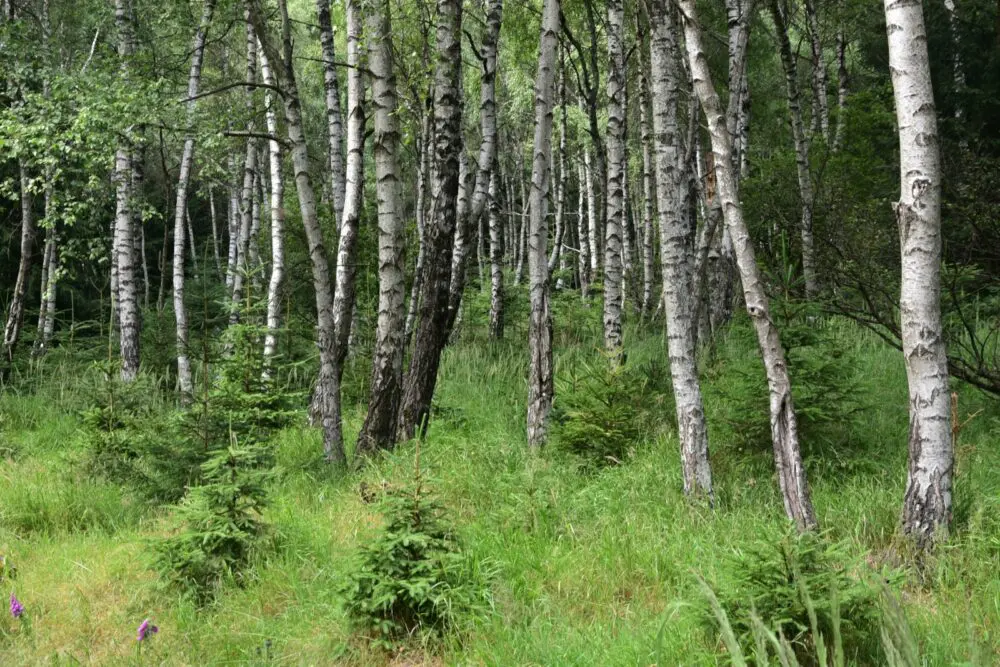
Photo: Birch stand underplanted with spruce, Ore Mountains, author Jan Řezáč
The article outlines the historical causes behind the collapse of spruce monocultures, including sulfur dioxide (SO2) emissions, inappropriate species composition, and pathogens. It also discusses interventions aimed at improving soil conditions, such as liming and magnesium (Mg) fertilisation. Most importantly, the article describes practical methods for transforming stands of replacement trees (PND) into diverse, climate-resistant forests that are rich in species and structure, all while keeping costs acceptable.
The authors demonstrate that the restoration of the Ore Mountains took place in several stages. This process began with the historical expansion of beech and fir trees, followed by the widespread introduction of spruce monocultures and the pollution disaster. Subsequently, there was a significant establishment of replacement tree stands (PND), particularly involving birch, rowan, larch, and blue (silver) spruce (Picea glauca).
The turnaround in this situation was aided by the desulfurization of pollution sources, which helped stabilize soil chemistry. However, the effects of climate change—such as drought, wind, frost episodes, and bark beetle infestations—are currently hurting these forests. This situation highlights the need for long-term adaptive management and a thoughtful transition towards diverse, multi-storey forest stands.
 Photo: Replacement birch stand underplanted with beech in the fence, Krušné hory, author Jan Řezáč
The case study compares the benefits of natural and artificial regeneration of forests. In higher and mountainous locations (6–7 LVS), natural regeneration of native species proves to be effective and economically advantageous. This approach typically involves lower initial costs, less damage from wildlife, and enables faster early development without the need for intensive protection.
In contrast, artificially established stands in poor or exposed sites encounter higher economic costs due to the need for protection and maintenance. These stands are also more susceptible to drought stress and biotic damage, requiring careful planning for stand management and associated density reductions.
Recommendations for Forest Practice
- Utilize natural rejuvenation as much as possible and work with the microclimate. When necessary, supplement with underplantings for an extended period to promote height differentiation.
- Ensure that planting materials are genetically suitable and of high quality. Take measures to prevent root deformation, particularly for covered-rooted seedlings, by ensuring mechanical stability.
- Adjust the regeneration process based on wind conditions: select the appropriate width and length for regeneration areas to restrict airflow. Prefer management techniques that create screens and retain approximately 10% of the area for natural development.
- Establish and maintain a network of subdivision lines to support the long-term cultivation and maintenance of stands.
- Conduct individual cultivation by positively selecting promising and target individuals. Foster long crowns and low centers of gravity, following the Bohdanecký principles and selection procedures according to Schädelin.
- In dry and polluted areas, consider stand density carefully to balance the risk of damage from snow and ice against overall stability. Avoid large-scale schematic interventions.
- Keep costs in mind: transforming stands can be financially demanding, so a balance between ecological goals and economic optimisation is essential.
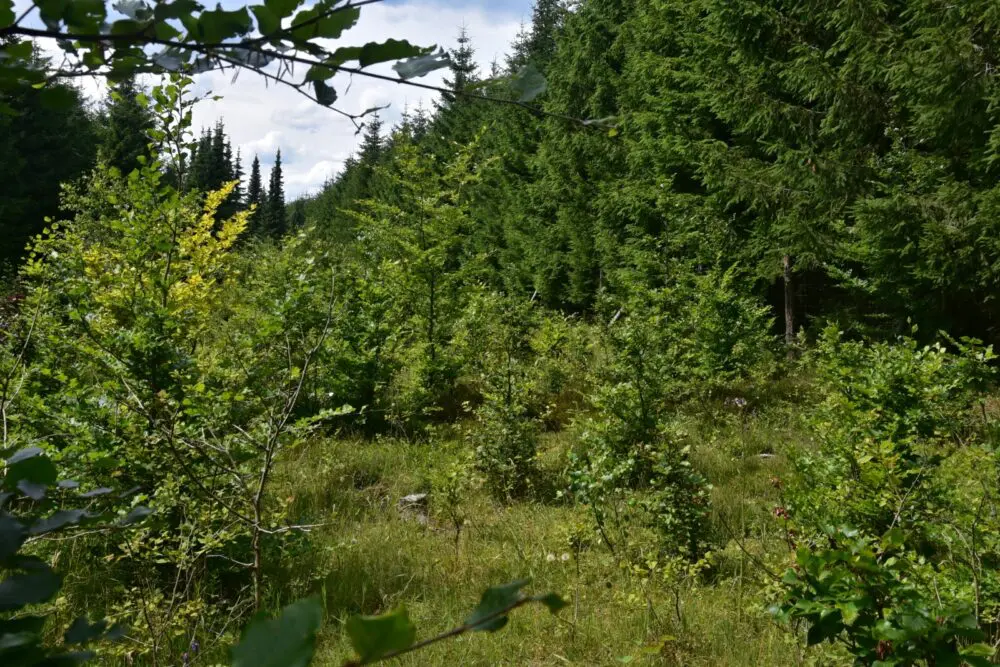 Photo: European beech planted within a fence serves as a buffer between older spruces in the Krušné hory, author Jan Řezáč
Model Management Examples
Large Area Clearing: After preparing the soil, pioneer birch trees are sown at low input costs. This is followed by selective mosaic thinning and a gradual introduction of target tree species based on local typological conditions. Within a span of 70 to 80 years, this approach aims to achieve a full canopy and transition to a richly structured stand with high resilience.
Residual Stands of Target Tree Species: It is essential to verify the genetic suitability of the remaining tree species, remove any unsuitable admixtures, prepare the soil, and restore the target climax tree species under the protection of the upper canopy. Long-term maintenance of height differentiation and mosaic structure in the stand is crucial, while also considering the site’s local hydrology and minimising necessary interventions.
Restoration of the Ore Mountains: This process requires adaptive management that focuses on biodiversity, vertical structure, and long-term resilience. Natural restoration should be prioritised where conditions permit, as it can reduce costs and enhance stand stability. While artificial regeneration has its place, it must be carefully targeted and economically justified. The ultimate goal is to create a functional, climate-resistant forest that maintains both production and non-production functions.
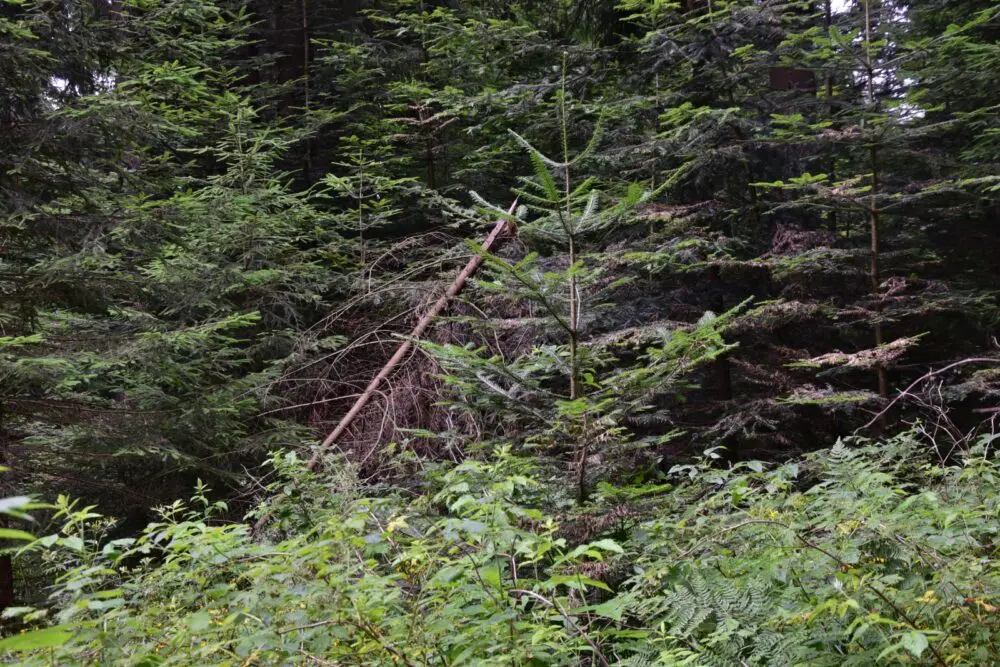 Photo: Silver fir returns to the Ore Mountains, author Jan Řezáč
The paper „Forest ecosystem restoration in the Ore Mountains: A review of silvicultural measures addressing environmental degradation“ can be downloaded here.
Authors: Veronika Hammerová, Stanislav Vacek, Zdeněk Vacek, Josef Gallo (Česká zemědělská univerzita v Praze, Fakulta lesnická a dřevařská); Jakub Černý (Výzkumný ústav lesního hospodářství a myslivosti, v. v. i.; Mendelova univerzita v Brně, Lesnická a dřevařská fakulta); Jan Cukor (Výzkumný ústav lesního hospodářství a myslivosti, v. v. i.; Česká zemědělská univerzita v Praze, Fakulta lesnická a dřevařská); Michal Kuběnka (Univerzita Pardubice, Fakulta ekonomicko-správní)
Prepared according original by: Jakub Černý, VÚLHM, v. v. i., e-mail: cerny@vulhmop.cz