

Long-term monitoring of beavers is essential for better protecting pond landscapes
The return of the European beaver to the Czech landscape is a notable success in species conservation. As an ecosystem engineer, the beaver significantly influences the environment of rivers and reservoirs. However, in intensively used pond landscapes, its activities can also cause damage to banks and dams, lead to flooding of surrounding areas, and interfere with tree growth.
 Photo: European beaver recorded by camera trap, author Ondřej Mikulka
A study conducted by scientists from Mendel University in Brno and the Forestry and Game Research Institute indicates that preventing conflicts requires detailed monitoring and location-specific solutions.
The current presence of the European beaver in the landscape is the result of long-term conservation efforts by various European countries. In the Czech Republic, the estimated population was around 4,000 individuals in 2015. By 2017-2018, this estimate had increased to between 6,000 and 7,000 individuals, and by 2020, the population was estimated to have reached up to 12,000 individuals. As the beaver population continues to grow, it is increasingly important to identify areas where their activities may conflict with farming or the safe operation of water management structures.
The European beaver is considered a highly endangered and legally protected species in the Czech Republic, with its protection governed by the European Habitats Directive. A European beaver care program has been established, which classifies areas based on different conservation objectives and levels of potential conflict. This strategic approach aims to preserve the natural development of the beaver population in valuable habitats while also addressing the needs of locations with sensitive water management infrastructure.
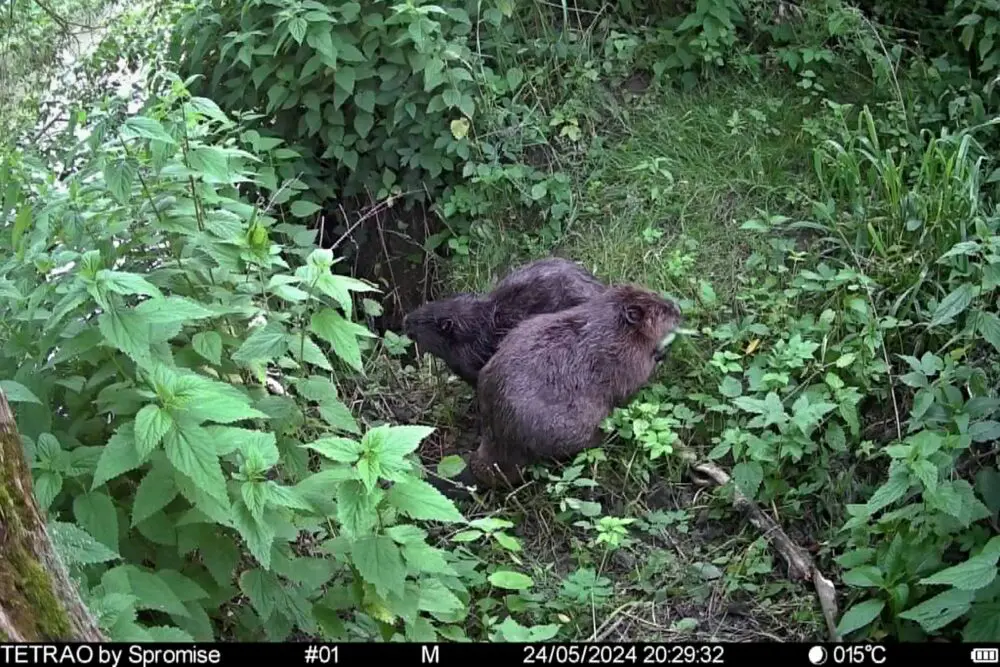 Photo: A pair of beavers is seen among the riparian vegetation, author Ondřej Mikulka
An essential part of the solution involves implementing preventive and technical measures, such as protecting trees, reinforcing dams and riverbanks, and using netting or stone shelters. The selection of these measures should depend on the specific type of damage, the characteristics of the location, and long-term monitoring of conditions. The presence of beavers or signs of their activity does not necessarily indicate a serious economic issue.
This research was conducted near the Pohořelice town in South Moravia. The local pond area is situated in a predominantly agricultural landscape, close to the confluence of the Svratka and Jihlava rivers. These ponds are primarily used for commercial fish farming, and their banks and dams are critical infrastructure that is vulnerable to burrowing, flooding, and other effects of beaver activity.
A total of 250 signs of habitation were recorded, with 81% consisting of tree gnawings. Researchers identified four active beaver territories spanning eight water bodies. The trees most frequently damaged were poplars and willows, which are common around these water units. However, food selection is significantly influenced by local availability. As a result, frequent gnawing of poplars or willows may not carry the same economic impact as damage to purposefully cultivated valuable trees like oaks and ash. When assessing the conflict, it is essential to consider not only the number of damaged trees but also their species, function, and location.
Spatial analysis revealed differences in the distance of gnawed trees from the water across the various water bodies. However, this relationship was not statistically significant and may primarily depend on the types of trees available at each site. The authors emphasize that their results should be interpreted cautiously. More precise knowledge of the movements of individual beavers would require methods such as GPS telemetry.
 Photo: Partial tree bite, author Jakub Špoula
The observed density of territories was comparable to values documented in river areas of the Morava basin, despite the Pohořelice landscape having a distinct character dominated by stagnant waters. The findings confirm that pond systems can create a suitable environment for beavers. However, they also indicate that the presence of this species should be evaluated separately from the actual risks posed to beaver dams, riverbanks, forests, and other economic interests.
The study highlights the importance of combining field research, spatial analysis, and an understanding of local conditions. This approach enables the identification of the most sensitive areas, allows for the targeted placement of preventive measures, and facilitates ongoing evaluation of their effectiveness. Efforts to protect beavers should be regionally tailored, respect their protected status, and address specific, demonstrable conflicts within the landscape.
The results of the study have been published in the journal “Zprávy lesnického výzkumu”.
The paper is available for download here.
The authors of the paper are Ondřej Mikulka, Jakub Špoula, and Martin Kincl from Mendel University in Brno and the Forestry and Game Research Institute, e-mail: spoula@vulhm.cz
Prepared based on the original by Jan Řezáč, VÚLHM, v. v. i., e-mail: rezac@vulhm.cz