

The long-term outlook for Norway spruce planted at lower elevations is not promising
 Historically, after significant disturbances, such as large-scale calamities that led to extensive salvage logging and the reforestation of cleared areas, foresters have carried out various long-term regeneration experiments. The recent bark beetle outbreak, which peaked around 2020, is no exception to this trend.
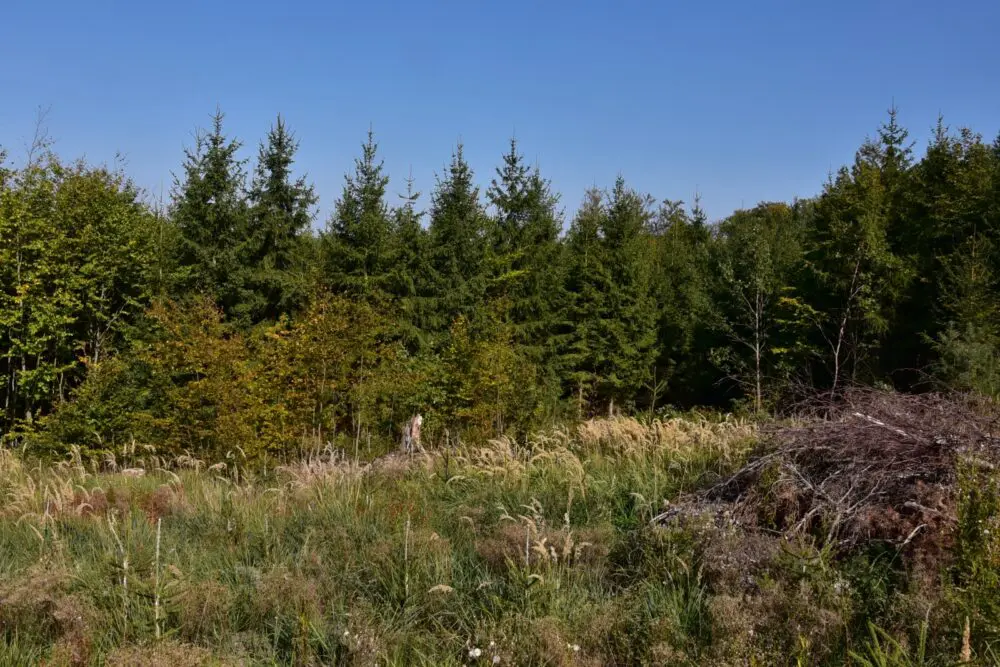
Photo: In a forest clearing, small spruces planted during artificial regeneration peek out from the grass. A pile of logging slash has been left to decompose naturally, allowing nutrients to return to the soil. Author Jan Řezáč
During the restoration of forests following a calamity, new and previously overlooked tree species, including non-native ones, are being tested. Direct seeding is being used on a larger scale, and various mixtures of species are under trial, with a significant emphasis on pioneer tree species. Additionally, foresters are increasingly focusing on natural regeneration, also known as ecological succession.
The success of artificial regeneration is assessed by low mortality rates and the healthy growth of planted trees, which ultimately leads to the establishment of a stable forest stand. These “establishment” criteria serve as a common benchmark for both artificial and natural regeneration. Another important criterion for successful restoration is economic cost; artificial regeneration can be several times more expensive than natural regeneration. Long-term viability for the planted trees is also crucial, ensuring they develop into stands capable of fulfilling all necessary functions throughout their life cycle.
One forest estate notably affected by a recent bark beetle outbreak is that of the Municipal forests of Znojmo (Lesy města Znojma). The outbreak progressed rapidly in this area and peaked in 2019, when over 100 hectares of clear-cut land were recorded and more than 70,000 cubic meters of bark-beetle-infested timber were harvested, an amount exceeding four times the typical annual harvest.
Between 2016 and 2024, nearly 470 hectares of clearings, created by extensive forest dieback, were reforested. The artificial regeneration primarily relied on four key tree species: Norway spruce, Scots pine, pedunculate oak, and sessile oak. However, the long-term outlook for spruce in this area is very poor. Its widespread use was mainly due to the urgent need to reforest the clearings quickly with readily available planting stock. In contrast, ample space was intentionally left for natural regeneration, and in many areas, common hornbeam began to emerge in large numbers as soon as the clearings were established.
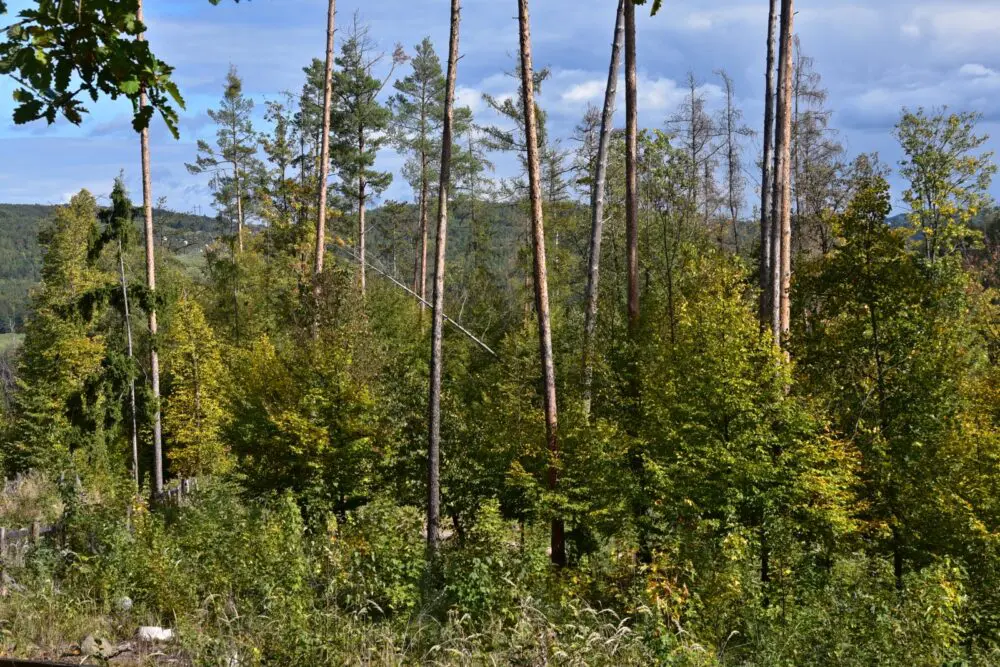 Photo: Natural regeneration featuring a diverse mix of broadleaved species growing beneath dying pine trees. Author: Jan Řezáč
The status of forest regeneration in areas affected by large-scale disturbances has become a key research focus for scientists at the Faculty of Forestry and Wood Technology at Mendel University in Brno. They presented their findings in an article titled “Hodnocení úspěšnosti postkalamitní obnovy na majetku lesů města Znojma” (Evaluation of the success of post-calamity forest regeneration in the Municipal forests of the city of Znojmo), published in the journal Zprávy lesnického výzkumu (Reports of Forestry Research). This article was developed as part of the TA ČR project SS020300188 „Centrum pro krajinu a biodiverzitu” (Centre for Landscape and Biodiversity).
The researchers compared various forest regeneration methods, specifically spontaneous (natural) and artificial regeneration, focusing on species such as pine, spruce, and oak. They evaluated the success of these regeneration methods from three perspectives: biological (considering factors like mortality and growth), economic (analysing regeneration costs up to the point of stand establishment), and legislative (assessing compliance with establishment standards). Their work quantifies the differences between natural and artificial regeneration in terms of costs and stand structure, providing a basis for making informed decisions regarding regeneration strategies for disturbed forest areas.
The majority of the territory managed by the Municipal Forests of Znojmo is located in the foothills of the Bohemian-Moravian Highlands, while only a small portion lies within the South Moravian Lowlands. Projections for 2030 suggest an average annual temperature of 9.1 °C, with average annual precipitation ranging from 501 to 550 mm. The area is predominantly composed of forest stands classified within the 3rd forest vegetation zone, which makes up 72% of the total. The 2nd forest vegetation zone accounts for 25%, while only about 3% falls within the 1st and 4th zones.
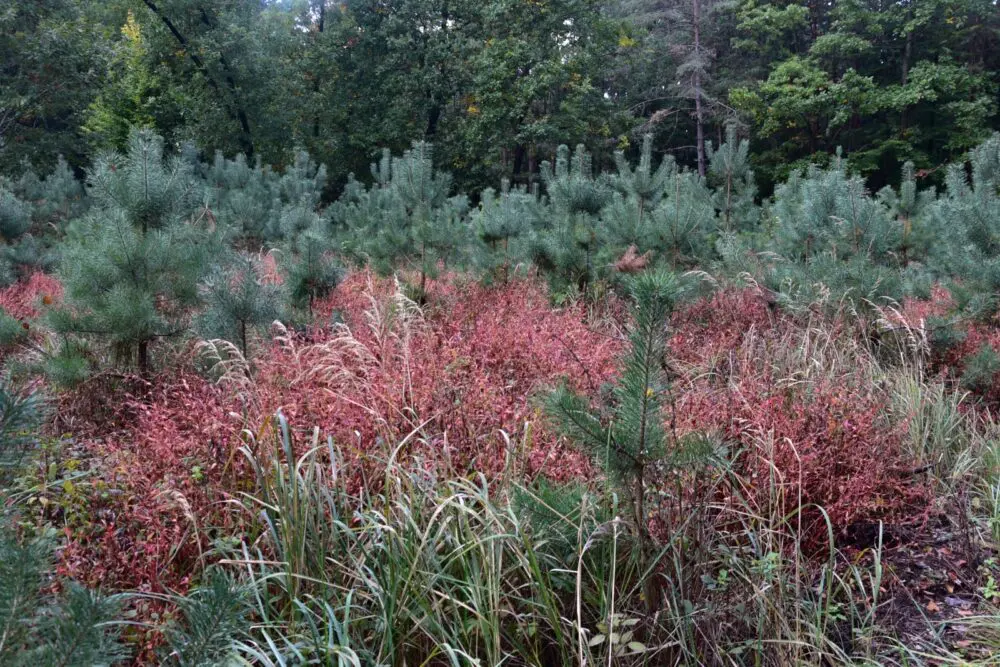 Photo: Young pines growing with wide spacing. Author Jan Řezáč
Five sites were selected for artificial regeneration of spruce and pine, and three sites for pedunculate and sessile oak. These were chosen to represent the majority of site types within the study area. Additionally, four more sites were selected under the same criteria to assess the status of spontaneous regeneration (succession). All sites were established in 2017.
Among the stands that underwent artificial regeneration, only those planted with pine were classified as fully established. In the case of oak (both pedunculate and sessile), full establishment could not be confirmed across the entire area of any stand. For spruce, only one of the five evaluated stands could be considered fully established. The main reason for these failures was attributed to drought.
Regarding the succession sites, the primary reason they did not meet the criteria for successful sapling Development, specifically, a lack of sustained height growth, was damage caused by browsing from red deer and roe deer.
The researchers aimed to learn from these experiences following large-scale disturbance events and to optimize the forest regeneration process in the affected clearings for the future.
At the Municipal Forests of Znojmo, reforestation efforts began during a crisis period, targeting approximately 150 hectares of clear-cut land. The primary objective was to restore forest cover as quickly as possible. For this reason, oak and pine were supplemented with extensive planting of spruce. However, cultivating spruce, and ensuring its long-term viability, poses significant risks under the prevailing local conditions, which are predominantly in the 3rd forest vegetation zone. This was confirmed during an assessment of the young stands, where the success of establishment was evaluated; among the tree species assessed, spruce showed the poorest performance.
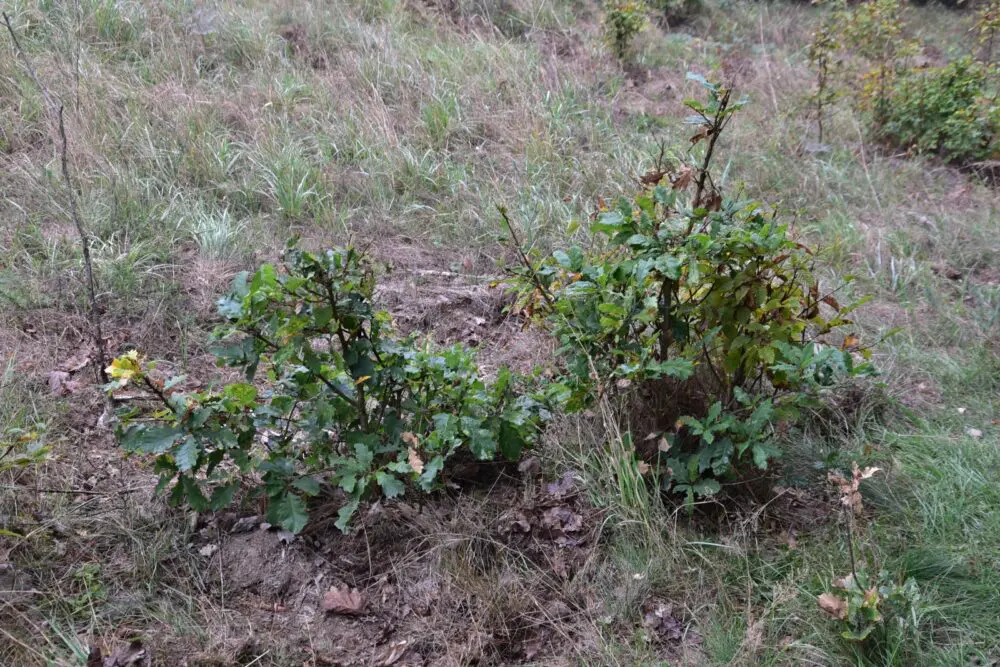 Photo: Unprotected young oaks damaged by game browsing; height growth is absent. Author Jan Řezáč
Considering the current site conditions and the ongoing impacts of global climate change, both pedunculate and sessile oak are ideal tree species for these environments. The future of developing stands will largely depend on how well shade-tolerant species, particularly hornbeam, can be introduced or maintained within them.
On the other hand, pine is regarded as a sub-optimal species for these sites. The outlook for existing pine stands will be more favourable if they can incorporate other tree species such as oak, hornbeam, and larch, which are regenerating spontaneously in abundance.
In areas intentionally left for natural succession, the establishment of regeneration has been successful, except in regions that are affected by chronic damage from game. These succession-based approaches are low-cost regeneration methods since they incur no expenses. However, implementing targeted and localized game protection measures, such as individual stem treatments or small-scale fencing in vulnerable areas, can enhance the status of regeneration efforts.
When assessing the parameters for successfully establishing artificially regenerated areas, sites replanted with pine performed the best, followed by those reforested with oak. In contrast, areas planted with spruce fared the worst and were largely deemed unsuccessful in their establishment.
 Photo: Fenced plantings are essential for protecting young forest plantations from damage caused by wildlife. Author Jan Řezáč
On the other hand, areas that have been reforested with spruce are the least expensive to manage. In contrast, regenerating oak is the most costly, mainly due to the necessity of fencing these areas.
A practical recommendation is to plant spruce as an admixture in rows when regenerating other tree species, particularly oak and pine. As a species that can tolerate moderate shade, spruce can create a beneficial lower canopy layer within the stands of these light-demanding species. However, the long-term survival prospects of spruce in these conditions remain uncertain.
In the long term, oak stands hold the greatest potential. In these stands, it is essential to maintain or introduce the desired admixture, especially hornbeam, which is the most common species found in stands that are left to regenerate naturally.
One limiting factor for the success of areas left for natural regeneration is the significant and recurring damage caused by game. The effectiveness of this approach can be improved by implementing specific measures to mitigate game damage. Additionally, it is advisable to introduce valuable tree species, such as wild service tree, Norway maple, or Turkey oak, into gaps within these stands, either individually or in groups, along with appropriate measures to reduce the population of ungulate game.
The paper “Hodnocení úspěšnosti postkalamitní obnovy na majetku lesů města Znojma” (Evaluation of the success of post-calamity forest regeneration in the Municipal forests of the city of Znojmo) can be downloaded here.
Authors: Pavel Karásek, Antonín Martiník, Mendelova univerzita v Brně, Lesnická a dřevařská fakulta (Mendel University in Brno, Faculty of Forestry and Wood Technology); e-mail: antonin.martinik@mendelu.cz
Prepared from the original by Jan Řezáč, VÚLHM, v. v. i.; e-mail: rezac@vulhm.cz