

We should take action to increase the presence of sycamore maple trees in our forests
 To transform the species composition of forests in the Czech Republic and enhance their ecological stability and species diversity in response to climate change, it is important to promote the expansion of native tree species that are currently underrepresented. One such species is the highly valued sycamore maple. Since sycamores are primarily found as scattered individuals rather than in dense stands, we cannot rely on natural regeneration alone. Therefore, it will be necessary to employ more artificial planting methods. In this process, it is vital to monitor the genetic variability of the sources of reproductive material to establish sufficiently resilient stands.
Scientists from the VÚLHM, v. v. i., Department of Forest Trees Species Biology and Breeding, studied the genetic diversity of the sycamore maple as part of their research project NAZV No. QK23020020. This project focuses on the “Utilization of DNA Analyses for Preserving Desired Genetic Diversity of Recognized Sources of Qualified Reproductive Material and for the Genetic Characterization of Populations of Less Common Autochthonous Forest Tree Species.” („Využití analýz DNA pro účely zachování žádoucí genetické diverzity uznaných zdrojů kvalifikovaného reprodukčního materiálu a pro genetickou charakterizaci populací méně běžných autochtonních druhů lesních dřevin“). They compiled their findings in the publication titled “Methodological Procedures of DNA Analyses for Verifying Clonal Affiliation and Genetic Diversity in Sycamore Maple (Acer pseudoplatanus L.)” („Metodické postupy DNA analýz pro ověřování klonové příslušnosti a genetické diverzity u javoru klenu“).
 Scientists have developed a certified methodology that utilizes DNA analysis procedures with nuclear microsatellite markers. This approach aims to objectively verify the affiliation of ramets (individual plants) to specific orthets (clones) and assess the level of polymorphism among clones in seed orchards or mixtures of sycamore maple clones.
Monitoring genetic diversity is crucial when selecting appropriate sources of high-quality reproductive material for establishing seed orchards. These orchards will provide seeds for planting new, genetically diverse stands that are more resilient and contribute to the biodiversity of forest ecosystems.
To date, a comprehensive description of the methodological procedures for DNA analysis using microsatellite markers to verify clonal identity and evaluate genetic variability among sycamore maple individuals has not been published for seed orchards or mixtures of clones in the Czech Republic.
The sycamore maple is a relatively large tree characterized by a straight trunk. Under favourable conditions, it can live for 300 to 400 years. This tree prefers semi-shaded environments and has higher demands for soil and air humidity. It typically thrives in humusy, moist soils that contain a significant amount of skeletal material and in rubble soils enriched with nitrogen. The sycamore maple features a deep, heart-shaped root system that is well-adapted to rocky soils, which helps strengthen the tree.
 It is the most widespread species of maple found in forests. However, its overall percentage in the current composition of our forests remains quite low. The tree is scattered throughout the Czech Republic, occurring in diverse environments, from floodplain forests to mountainous regions.
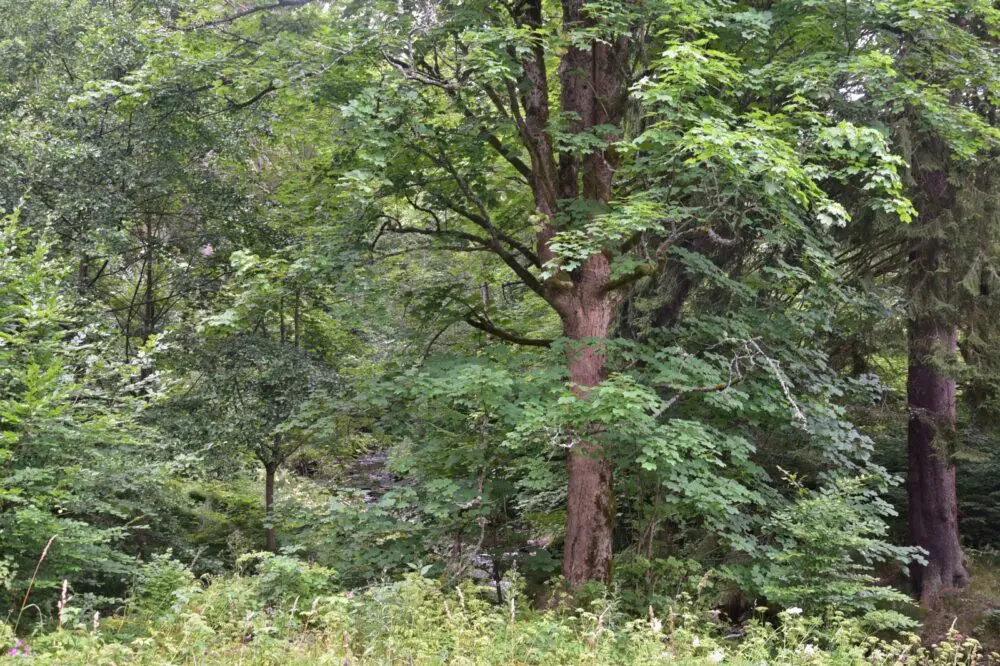
The primary distribution of sycamore maple is in the foothills and mountains, where it grows alongside beech and spruce forests. This tree is particularly common and thrives in cool ravines and valleys near streams in rubble forests, often found in conjunction with other rubble trees. The leaf litter from sycamore maple significantly enriches the soil, and the tree also flourishes in moistened gravel. Its wood is solid, scattered, and porous, making it valuable for various applications, including carpentry, wheel righting, carving, and the production of musical instruments.
It is essential to investigate the variability in reproductive sources due to the typically scattered distribution of sycamore maple. To establish stands that are more resilient to climate change, it is crucial to start with a genetically diverse breeding base, where the level of variability can be accurately assessed through DNA analysis. Enhancing the genetic variability of these stands will contribute to their increased resistance to diseases, pests, and adverse climatic conditions.
The developed methodological procedures for DNA analysis play a crucial role in recognizing seed orchards in accordance with the National Program for the Protection and Reproduction of the Forest Tree Gene Pool. A requirement for obtaining a subsidy title is the collection of reference samples, which will allow for future verification of the accuracy of clones derived from selected orthets through DNA analysis.
 Additionally, these methodological procedures aimed at understanding the genetic diversity of sycamore maple contribute to the goals outlined in the newly approved long-term strategy for enhancing protection and promoting sustainable biodiversity, specifically the “Strategy for the Protection of Biodiversity of the Czech Republic 2026–2050” („Strategie ochrany biologické rozmanitosti České republiky 2026–2050“) and the subsequent “Action Plan for the Period 2026–2030.” („Akční plán pro období 2026–2030“.These initiatives align with the international commitments of the Czech Republic”).
Overall, the methodological procedures for DNA analysis used in the genetic identification of sycamore maple individuals provide societal benefits and support the preservation of the gene pool of this underrepresented tree species in the Czech Republic.
One important economic aspect is the benefits for forestry. The reproduction of gene-rich populations ensures the development of more stable and resilient stands, which will enhance biodiversity, better adapt to potential climate changes, and contribute to environmental protection.
Alongside these societal benefits, forest owners can realistically expect an increase in revenue from the sale of wood due to higher future yields from stands based on high-quality reproductive material. A better genetic production base enhances both the quantity and quality of harvested timber, thereby improving the economic viability and competitiveness of sustainable forest management. The production goal for growing sycamore maple is to cultivate individual trees with maximum mass and a straight, knot-free stem.
Publication “Methodological Procedures of DNA Analyses for Verifying Clonal Affiliation and Genetic Diversity in Sycamore Maple (Acer pseudoplatanus L.)” („Metodické postupy DNA analýz pro ověřování klonové příslušnosti a genetické diverzity u javoru klenu“).can be downloaded here.
Authors: Ing. Helena Cvrčková, Ph.D., Ing. Pavlína Máchová, Ph.D., Ing. Olga Trčková, Bc. Kateřina Vítová, VÚLHM, v. v. i.; e-mail: cvrckova@vulhm.czz
Prepared according to the original by Ing. Jan Řezáč, VÚLHM, v. v. i., e-mail: rezac@vulhm.cz
Illustrative photo: Sycamore in the Ore Mountains, author Jan Řezáč